
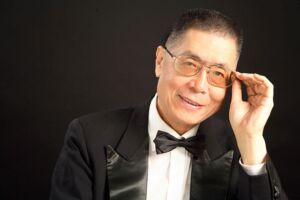
Lau Sze Kwan was born in a wealthy merchant family in 1939. Half of his relationship with the piano came from his father’s influence. He started learning piano at the age of 3, and performed at the age of 5. At the age of 10, he won the highest level of the piano competition for children in Shanghai. After that, he successively participated and learnt in the Junior Class of the Shanghai Conservatory of Music, the Central Conservatory of Music, and the Central Conservatory of Music.
In 1956, Lau Sze Kwan won the third place in the Liszt International Piano Competition in Hungary and a special prize for the performance of “Hungarian Rhapsody”. He was awarded a prize by the Hungarian government by making an exception from Liszt’s hair preserved in the National Museum to this Chinese youth. Due to his excellent grades, he was also sent to the Moscow Conservatory of Music to study abroad.
In April 1958, the first Tchaikovsky International Piano Competition was held in Moscow. This was the world’s top piano competition, which was recognized as the highest level and the most difficult at the time, and was known as the “Highest Olympiad in the International Music Circle”. Lau Sze Kwan won the second place. The Soviet leader Khrushchev personally telegraphed to congratulate Chairman Mao Zedong and Premier Zhou Enlai. Thus he became famous in the world music scene.
In 1964, he was personally received by Chairman Mao and had a profound conversation with Chairman Mao. In 1978, he became the first artist to visit the United States on behalf of Mainland China, and US President Carter met him at the White House. Since 1990, Lau Sze Kwan has devoted himself to children’s music education and has lived in Hong Kong for a long time.
The old generation of Chinese leaders Mao Zedong, Zhou Enlai, Liu Shaoqi, Deng Xiaoping, etc. have listened to Lau Sze Kwan’s performance and had long talks with him. Contemporary Chinese leaders such as Jiang Zemin have also listened to him.
The former supreme leader of the Soviet Union, the President of the United States, the President of France, the Prime Minister of Denmark, the Prime Minister of Poland, the Queen Mother of Belgium, the Speaker of Hungary, and the Deputy Prime Minister of Singapore have all met him. British Prime Minister Sheehan has written to him.
He has played in dozens of countries in the world, and many countries including China, the United States, Japan, and Russia have recorded and released his records many times. Among them, the Piano Association Records, which he recorded in collaboration with the Boston Symphony Orchestra conducted by the world conductor Seiji Ozawa, has become one of the world’s most popular classical music gold records. He has also lectured in many countries and served in many international pianos competition judges.
劉詩昆1939年出生於在一個富裕的商人家庭裏。他與鋼琴結緣,一半來自父親的影響。他3歲開始學習鋼琴,5歲即登台演出,10歲時,在上海舉行的全國最高級別的少年兒童鋼琴大賽一舉奪冠,之後他先後在上海音樂學院少年班、中央音樂學院附中、中央音樂學院學習。
1956年,劉詩昆在舉行於匈牙利的李斯特國際鋼琴比賽中榮獲第三名及《匈牙利狂想曲》演奏特別獎,獲匈政府破例從國家博物館保存的李斯特的頭髮中取出一束作為獎品獎勵給這位中國少年。由於成績優秀,他也被公派送到莫斯科音樂學院留學。
1958年4月,第一屆柴可夫斯基國際鋼琴比賽在莫斯科舉行。這是當時被公認為水平最高、難度最大的,被稱為“國際樂壇最高奧林匹克賽”的世界頂尖鋼琴賽,劉詩昆奪得第二名。蘇聯領導人赫魯曉夫親自拍電報給毛澤東主席和周恩來總理表示祝賀。從而蜚聲世界樂壇。
1964年,獲得毛主席親自接見,並與毛主席進行了一次深刻的談話。1978年,成為代表中國內地訪問美國的第一個藝術人士,美國總統卡特在白宮接見他。1990年起,劉詩昆投身到兒童音樂教育工作中,長居香港。
中國老一代領導人毛澤東、周恩來、劉少奇、鄧小平等都專門聆聽過劉詩昆的演奏,並分別同他長談,江澤民等當代中國領導人也都聆聽過他演奏,原蘇聯最高領導人、美國總統、法國總統、丹麥首相、波蘭總理、比利時皇太后、匈牙利議長、新加坡副總理等都接見過他,英國首相希恩曾致信於他。他曾到世界上數十個國家演奏,中、美、日、俄等多國都曾多次錄製發行他的唱片。其中,他同世界指揮家小澤征爾指揮的美國波士頓交響樂團合作錄製的鋼琴協唱片,曾成為世界行銷量最多的古典音樂金唱片之一,他還曾在諸多國家講學,及擔任多個國際鋼琴比賽評委。